Memory Is Not Built Once: fragile architect(ure) at DIMIN

At DIMIN, fragile architect(ure) brings together works by Russell Maltz, Ben Blaustein, Alex Stern, and Emerald Rose Whipple under a curatorial premise that situates memory “as an anchoring framework onto which the rest clings.” Francesca Pessarelli’s press release begins with a quote from Louis Bourgeois: “You pile up associations the way you pile up bricks. Memory is itself a form of architecture.” Pessarelli curates the exhibition with works that draw parallels between architecture and memory, they feel modular, fragmentary and at times, subject to rearrangement. It is an inviting metaphor, one that offers viewers a path into the work without demanding fluency in dense theoretical language. With the scaffolding raised, the pressing question becomes what memories will we experience and which are stabilized, which are left fragmentary, and which are excluded.
That question matters because the exhibition does not simply illustrate the idea of memory as accumulation. It stages a more uneven terrain in which memory appears precarious, intimate, damaged, and ephemeral. Using sculpture, painting, and assemblage, the artists share an investment in layering, structure, and partial visibility, but the works do not arrive at the same emotional or formal destination. Some works feel tender and private; others feel emotionally cool, restrained, or held at a distance. Some are literally fragile, using glass, paper, suspended elements, while others suggest fragility metaphorically. The exhibition is strongest not because it circles around one image or framework but because it allows difference to remain and create tension.
Russell Maltz’s works make fragility feel most literal. White Veil Stack, positioned near DIMIN’s front window, consists of six panes of glass stacked against one another on a clean aluminum shelf. The friction between the panes, and between the panes and the shelf, seems minimal, giving the sense that the whole arrangement could come crashing down at any moment. Yet the work maintains its composure even with its quiet precariousness. Rather than dramatizing instability, Maltz rewards the viewer for experiencing the work through careful looking.
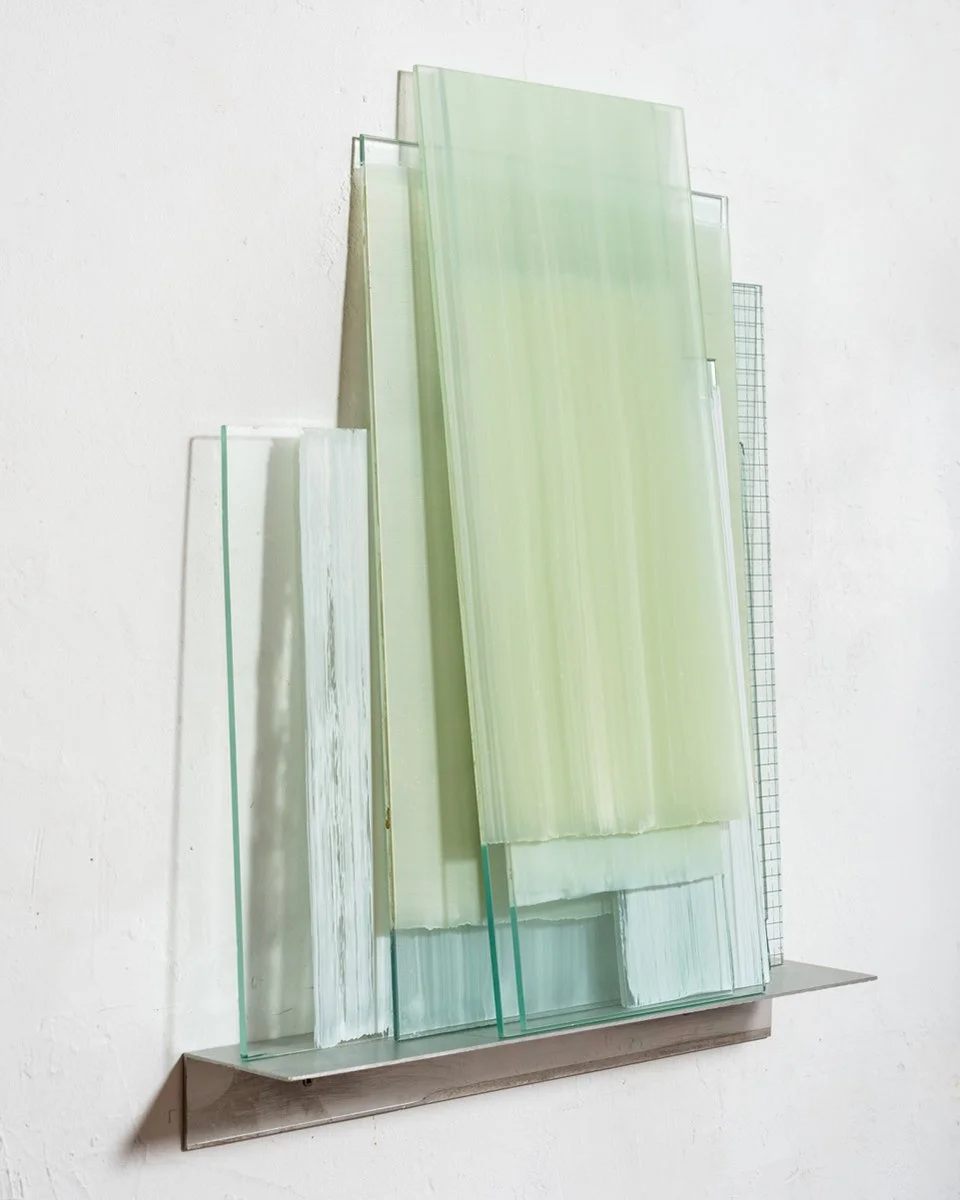
Russel Maltz White Veil Stack, 2021, Polyurethane and enamel on clear and wire glass (6) plates stacked on aluminum shelf, 26 1⁄2 x 22 x 4 in, Courtesy of the artist and DIMIN
Among Maltz’s works in the exhibition, White Veil Stack is the odd one out. Unlike the hanging works nearby, it remains grounded, and its upright, rectangular shape makes it feel more referential to painting than to mobile or hanging sculpture. The rear pane of glass contains embedded wire and introduces a subtle but important shift in the work. The gridded wire implies structure, support, and rigidity: something like a foundation behind the more ethereal planes in front. The stacked panes read as strata, each layer holding traces of what lies before and behind it. Much of the glass is painted with thin applications of polyurethane and enamel in muted pastel hues, though the material is left untouched in a number of spaces. The boundaries between painted and unpainted areas create a tension between the end of the brushstroke and the end of the pane itself, and allow for play with transparency to activate the work.
This transparency rewards quiet, intentional viewing. Many of the painted areas are nearly opaque, but in the lower center of the piece, and in a few other carefully staged passages, multiple panes interact to create real depth, allowing the eye to move through several layers at once. Near the gallery’s front window, those layered depths enter into conversation with the sights and sounds of Canal Street below. Functional glass and sculptural glass begin to echo one another and reflect the movement of viewers.
Maltz’s hanging works extend this concern with balance and suspension into vertical space. S.P. / Chrome Electra #12, composed of stacked elements that include wire glass and a steel bar, hangs from a single steel rod. While it feels less precarious than White Veil Stack, the work still relies on a concentrated point of support. Its elements stretch from floor to ceiling with a strange slackness, as if a formerly precise measuring device had failed. The piece recalls a broken watch or clock, its elongated parts hanging like hands that no longer keep time. The frontal pane of wire glass becomes a screen through which the steel bar behind it can be seen, and the work’s structure maintains the logic of stacking while consolidating into a more unified vertical object.
The other hanging work, S.P. / ACCU-FLO Needle Series, shifts from glass to wood, alternating between raw exposed material and vivid orange Flashe paint. It descends with a more dramatic change in angle, pulling the eye downward. If the wire-glass work resembles a broken clock, this piece feels closer to a failed metronome. Across Maltz’s contributions, one begins to feel that these are works of balance, gravity, and calibration. Their fragility feels at times literal and at other times implied.
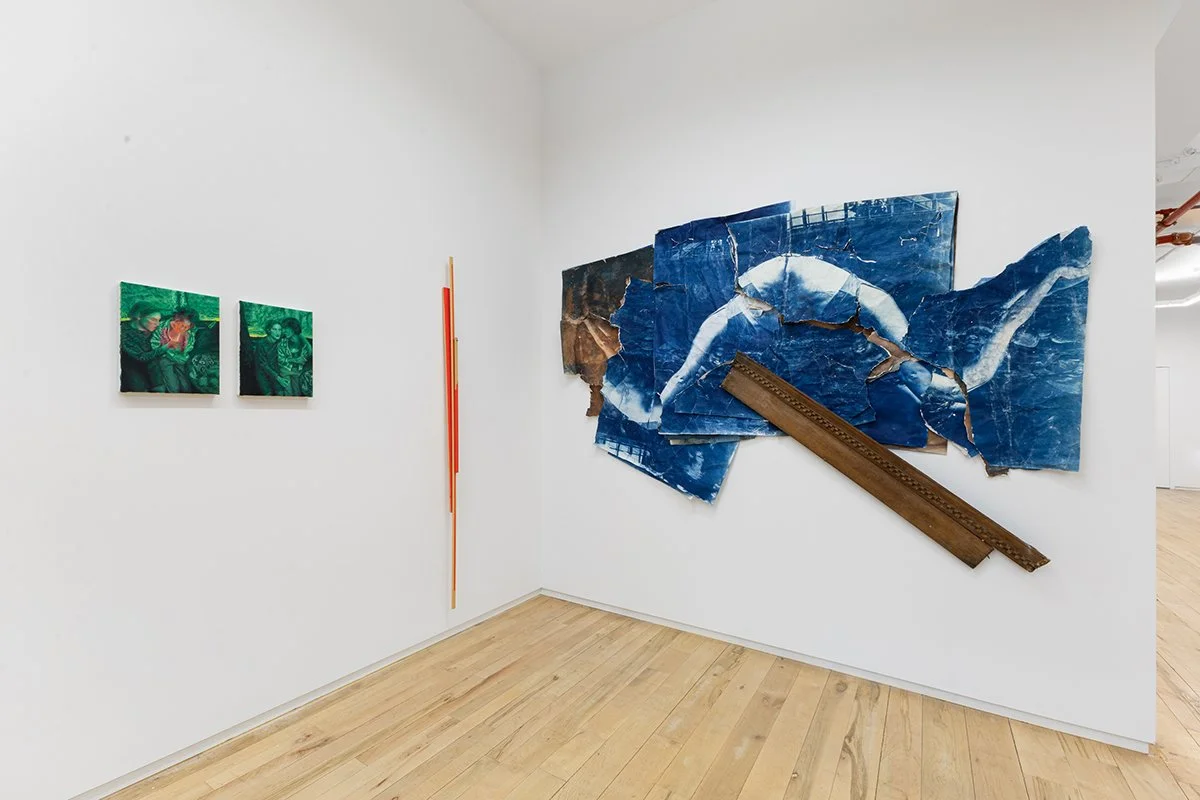
Installation view, fragile architect(ure), courtesy of DIMIN, ©Justine Hill
If Maltz’s work approaches memory through support, stacking, and suspension, Ben Blaustein’s cyanotypes approach it through damage, attachment, and the afterlife of images. His works introduce a different kind of fragility, one tied less to balance than to abrasion, distress, and the instability of preservation itself. While the exhibition imagines memory as something fragmented, Blaustein’s works suggest something even harsher, memory actively altered by attempts to represent it singularly.
His hanging cyanotype piece, Dissolving Boundaries, consists of multiple prints joined by metal grommets and suspended, in part, from the dismembered leg of a table. The table leg is not a neutral found object. It carries the charge of domestic use, of prior life, of a material history no longer accessible. Blaustein has compared the grommets to the golden rings used to bind certain religious texts, and that analogy is useful: the grommets do not simply fasten, they ritualize attachment. They puncture the image surface and, in doing so, allow for glimpses through it. What would otherwise remain opaque becomes perforated. At times, the viewer can see fully through the hanging work; at others, the holes offer only partial access to its layered interior, including reverse sides of folded or overlapping prints.
The piece drapes like a scroll, one end hanging and the other stretching onto the gallery floor toward the front window. There is something humorously resonant in that orientation: cyanotypes are made through exposure to natural light, and here the work seems almost to crawl back toward the condition of its own making. At the same time, the prints are visibly distressed. They are crumpled, torn, and wrinkled, and the palette shifts beyond the expected deep blue of the cyanotype into purples, greys, pinks, and blacks. These variations do not merely add visual complexity; they register the instability of the photographic surface itself. This is not memory as clean retention but memory as something damaged in the attempt to preserve it.
Blaustein’s cyanotype on copper, Recall, Repose, is one of the exhibition’s most compelling works. The image appears to show a figure drying off, bent forward toward the viewer, with a towel pulled between their calves. The long, wet hair creates a chaotic cluster of marks, while droplets on the figure’s back catch the light and form delicate patterns across the body. Hair and water both become systems of rhythm, nearly abstract in their repetition, and these play against the subtle patterning of the copper plate beneath. The print is affixed mechanically with small silver screws at each corner. What might at first read as a temporary attachment reveals itself as unexpectedly permanent. In this way, this work too rewards close looking.

Ben Blaustein, Recall, Repose, 2026, Cyanotype on paper toned with botanicals on copper aluminum, 36 x 36 in, courtesy of the artist and DIMIN, ©Justine Hill
A noticeable tear enters from the left side of this work and extends horizontally past the center of the image, interrupting the figure without obscuring it. The composition is also off-center, shifted up and to the right so that an oddly proportioned L of exposed copper remains visible on the left. The figure bends toward the viewer’s right, mirroring that compositional imbalance. There is tenderness here, though the figure's averted gaze resists it becoming someone recognizable.
Blaustein’s largest work, a cyanotype composition titled Divers (after Muybridge), is positioned opposite from the large window in which a bent figure emerges in saturated blue, surrounded by layered, distressed prints in sepia and rust tones. A found, mantel-like architectural fragment cuts diagonally across the composition, crossing the figure’s posture and producing an X-shaped structure that keeps the composition visually dynamic. A faint wooden railing within the printed image echoes the mantel’s linear quality, linking depicted architecture to literal support. Here again, Blaustein does not treat memory as a stable scene recovered from the past. He treats it as something layered, torn, and partially obstructed, recording distortion through materiality.
Alex Stern’s paintings push the exhibition in another direction. If Blaustein’s work emphasizes damage and material abrasion, Stern’s paintings suggest memory through layering that hovers between image and abstraction. I Live For You, embodies this layering most directly. Vertical bands of green in varying hues and saturations create a field that initially suggests a bamboo forest or thicket, though the image never fully coheres into a recognizable scene. Tans, yellows, and oranges produce subtle depth, while horizontal bands near the top cap the composition almost like strata or plywood layers. While there are grids throughout, they never feel rigid enough to slow the painting’s sense of movement.
What holds attention here is the push-pull between trying to read the work and simply allowing oneself to remain with its materiality. Stern creates a field in which recognition almost surfaces, then escapes. Rather than the paint lying flat in the manner of some modernist grid, the bands of color move physically above and below one another, creating an effect closer to weaving than to abstract geometry. The painting uses mark and process as a way to record the history of its own creation.
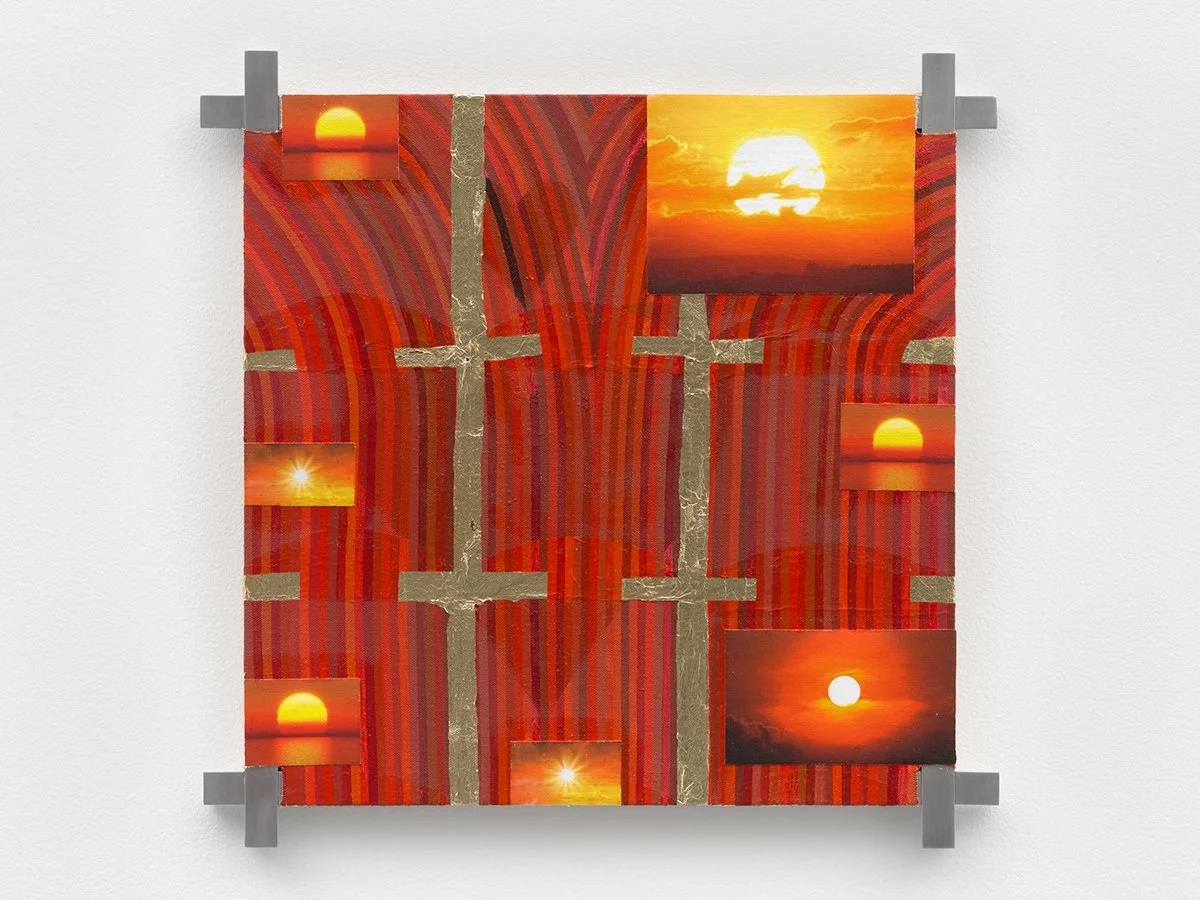
Alex Stern, New Water (Red Sun) (Metal Bars), 2023 Acrylic, oil, gold leaf, and inkjet on linen mounted on custom artist support, 18 x 18 in, courtesy of the artist and DIMIN, ©Shark Senesac
In New Water (Red Sun) (Metal Bars), Stern’s use of gold leaf is more obvious, and the composition feels suggestive of the tiered arcades of ancient Rome. Vertical bands of color begin at the bottom, then spread outward from the center, while half-ovals and triangular forms interrupt the structure. In the upper left, some of these forms nearly create a heart, an image that feels almost too timely given the exhibition’s opening just before Valentine’s Day. But the more significant shift lies in Stern’s use of inkjet prints on linen. Seven small images of sunsets or sunrises adhered onto the painted field interrupt the abstraction. Perhaps these images are references to the golden hour, and through that reference play with the use of gold leaf in this work.
Unlike I Live For You, which ends in surrender for the search for an image, New Water (Red Sun) (Metal Bars) prompts a prolonged attempt towards interpretation. The aluminum support extends beyond the square of the pictorial field, projecting outward and echoing forms created in gold foil. This expanded structure does not feel restrictive so much as expansive, as though the painting were expanding beyond its own pictorial space. Stern’s work introduces a cooler, more analytic register into the exhibition. In a way, it is less intimate than Blaustein or Whipple, but it is no less invested in the idea of memory as a layered construction.
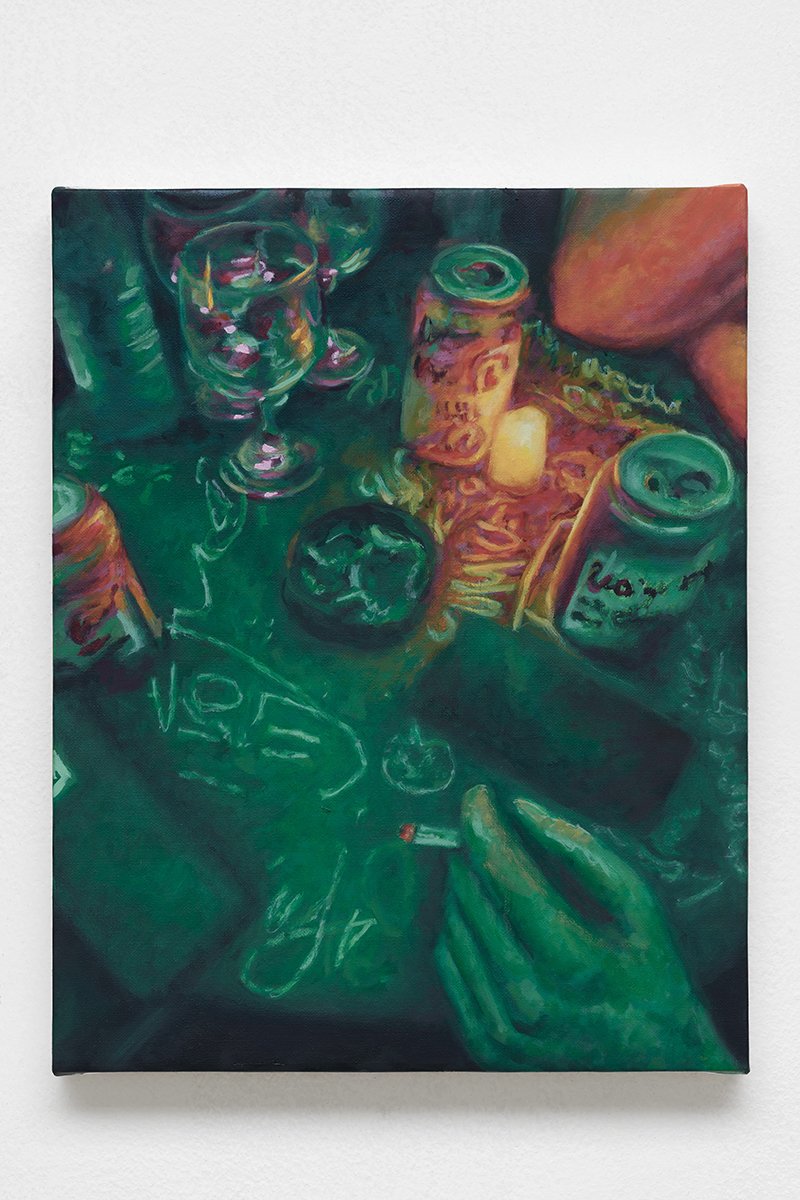
Emerald Rose Whipple, Mike & Kevin at Mansions, 2026, Oil on linen, 14 x 11 in, courtesy of the artist and DIMIN, ©Thomas Mueller
Emerald Rose Whipple’s paintings bring the exhibition into a more explicitly social and affective space. Her three works are infused with green and punctuated by glowing yellows and oranges, producing the eerie atmosphere of bars, cigarettes, candles, and nightlife interiors. In Mike & Kevin at Mansions, a dive-bar table appears scratched, written upon, and marked by prior use. A largely smoked cigarette is held in one hand and empty wine glasses and opened cans remain on the table. A glowing central object throws strange yellows and purples across the scene, making it feel intimate and also alien. Without the viewer’s own knowledge of dimly lit bars and shared night spaces, the image would be harder to access. The paintings utilize, in part, shared cultural memory to realize their full potential.
Dylan and John at Mansions feels even more intimate. In it, two figures occupy the same booth-like, green-lit environment. In one, a figure lights the other’s cigarette while in the other, the pair sit in embrace. One looks longingly at the other while the second engages the viewer more directly. Whether these works move narratively from right to left or left to right remains unclear and this ambiguity adds to the ethereal feeling Whipple’s works produce. The paintings are hazy and sickly, their soft blending producing a sensation that is less nostalgic than groggy, uneasy and sluggish. In Whipple’s work, memory does not feel clarified; it feels emotionally and visually blurred.
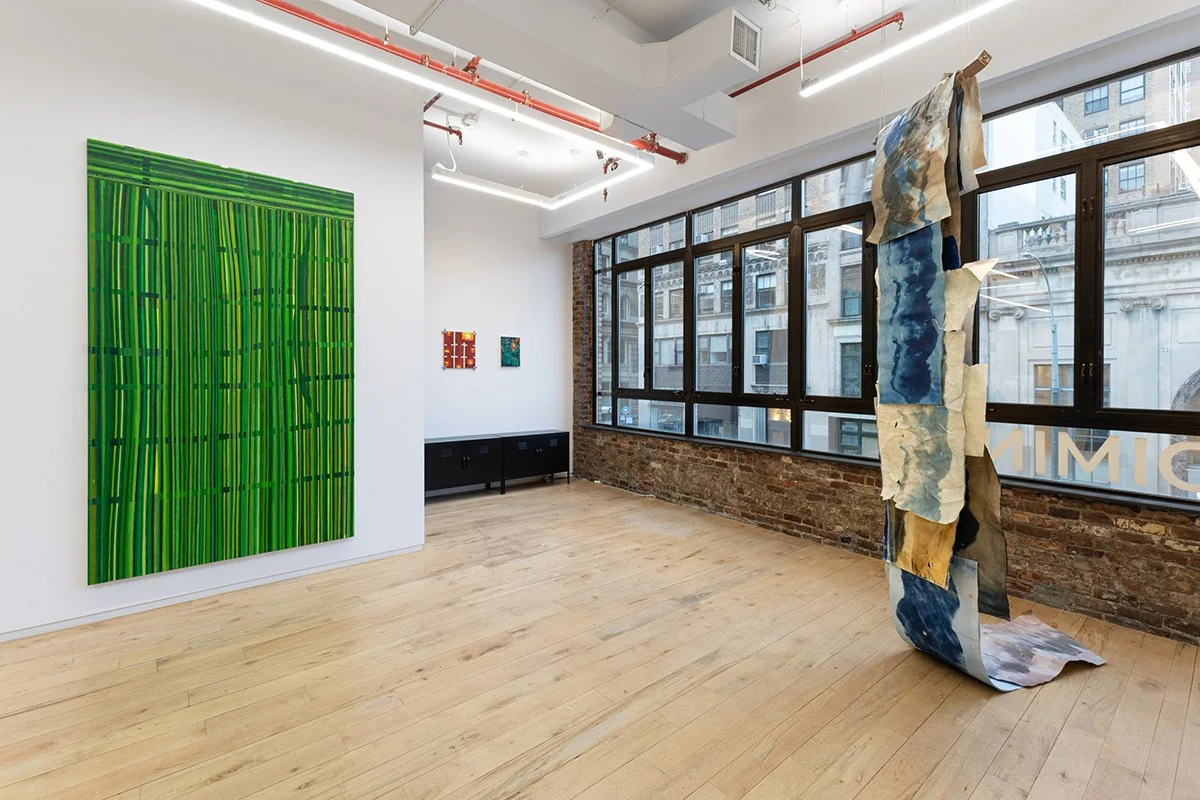
Installation view, fragile architect(ure), courtesy of DIMIN, ©Justine Hill
fragile architect(ure) is most compelling because of its ability to address fragility in diverse ways. Fragility is literal in Maltz’s glass, material in Blaustein’s torn paper, structural in Stern’s layered supports, and emotional in Whipple’s intimate scenes. The exhibition’s focus, memory as architecture, is useful but should not be mistaken for a total explanation. What the show demonstrates is that memory is built but not in a single way. It stacks, tears, hangs, obscures, and expands. It is not only accumulative and affective; it is also selective, materially contingent, and uncertain. Francesca Pessarelli’s curation succeeds not because it proves memory is architectural, but because it stages several distinct architectures of remembering and lets their differences tell a story.