Flying House Arts Collective Inserts Artworks in a Second-Hand Store
Published February 23, 2026 in BmoreArt
In a secondhand store, objects arrive severed from their makers, their histories, and ultimately their original contexts. Images, materials, and narratives circulate much in the same way. Ideas are worn, altered, passed on, and ultimately recontextualized. Against this backdrop of circulation and reuse, Rui Jiang and the Flying House Arts Collective have assembled thirteen Baltimore-based artists to question the very premise of artistic authorship.
Currently on view through March 7th at EGATNIV, a vintage store in Baltimore’s North Avenue Market Slippy Authorship, exists less as a traditional show within a retail environment and more of a conversation about ideation within artmaking.
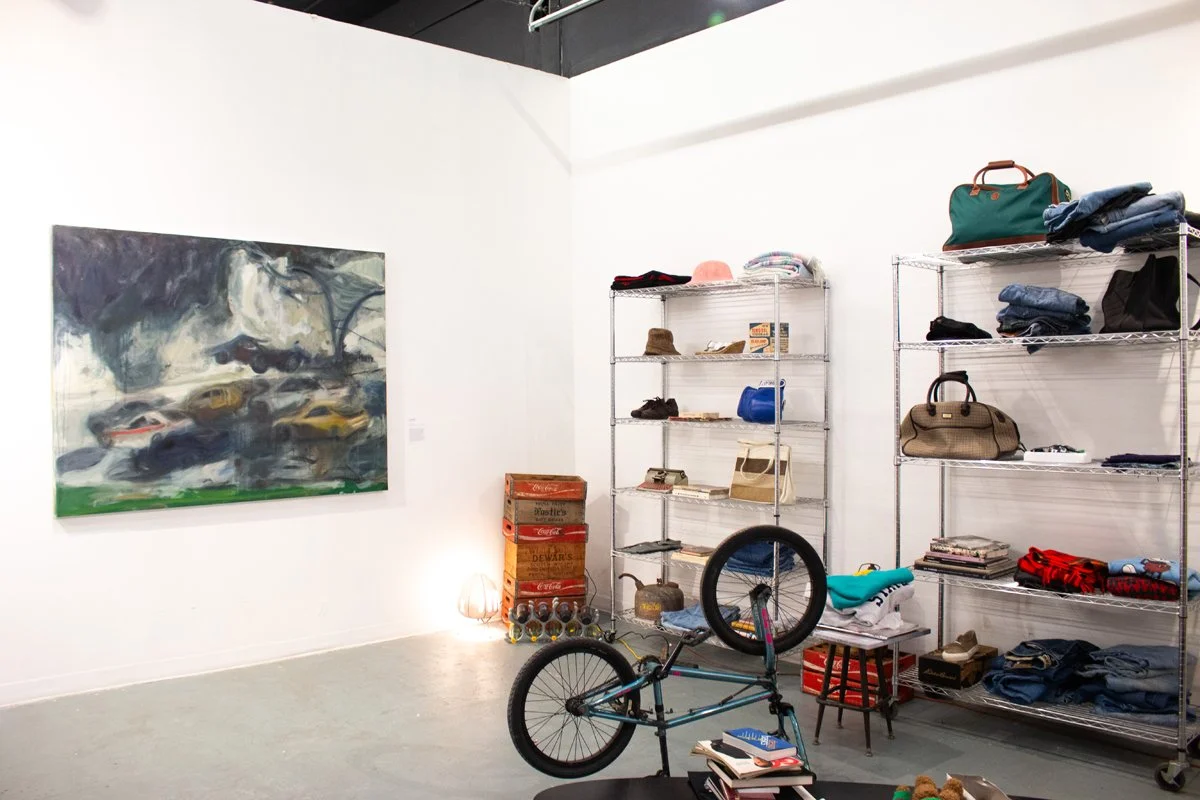
Clothing racks, atypical nooks, and narrow corridors do not function as obstacles to viewing but as active components in not only how you move through the space but also what work is shown and where. The installation is masterfully laid out, attention to sightlines, scale, and proximity produce an effective flow between works. Rather than imposing a white-cube logic onto a commercial interior, curator Rui Jiang allows the exhibition to mobilize the store’s existing rhythms and plays off of the idea of commercial browsing.
The title Slippy Authorship signals a refusal of artistic origin as a stable point of departure. By staging contemporary artworks within a site defined by reuse, the exhibition proposes that finished artworks can also exist in a state of flux relative to their contexts.
The act of reuse and recontextualization may be most evident in the art of Ellie Works. Her mixed-media constructions embrace excess. Straddling painting and sculpture, Works incorporates found objects into surfaces that often suggest excavation within a larger practice of composition. Cell phone components, stones, soap, and fragments of domestic hardware all blend masterfully with more traditional materials like oil paint. Her practice treats the substrate as both support and subject, pierced and manipulated in ways that foreground its status as material rather than illusionistic ground.
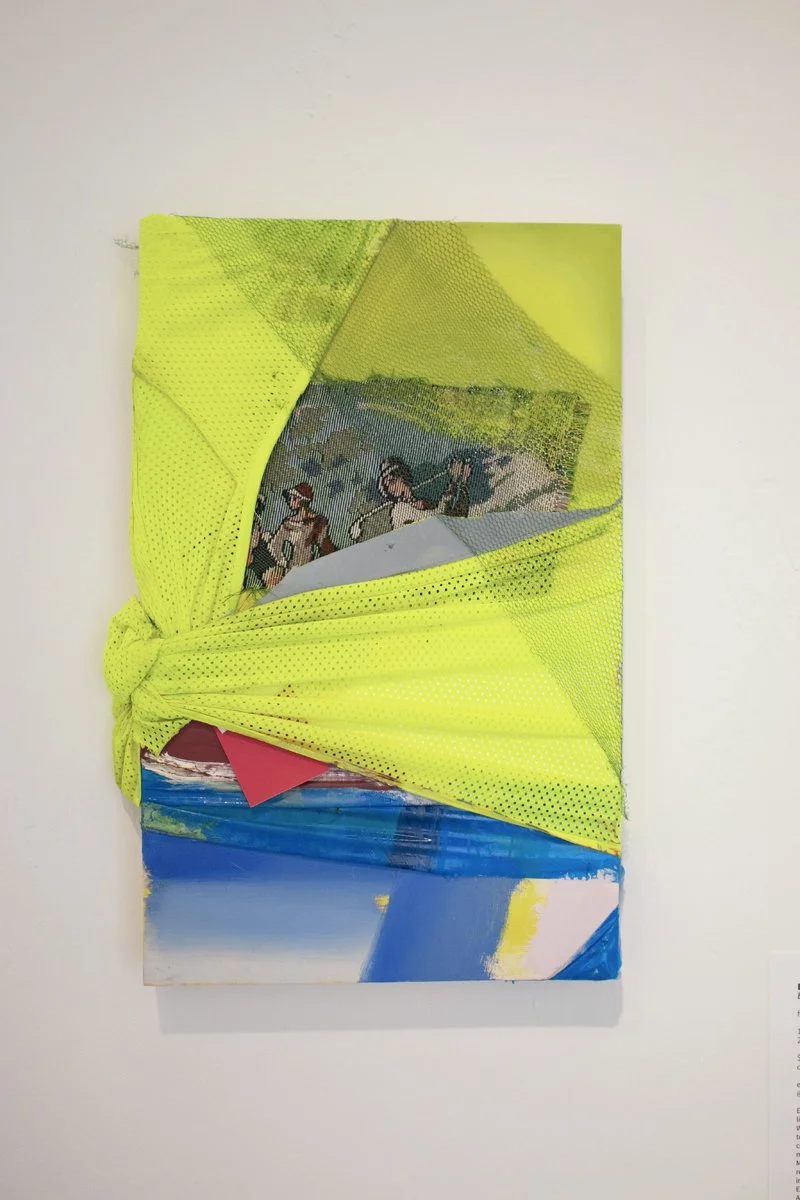
Ellie Works
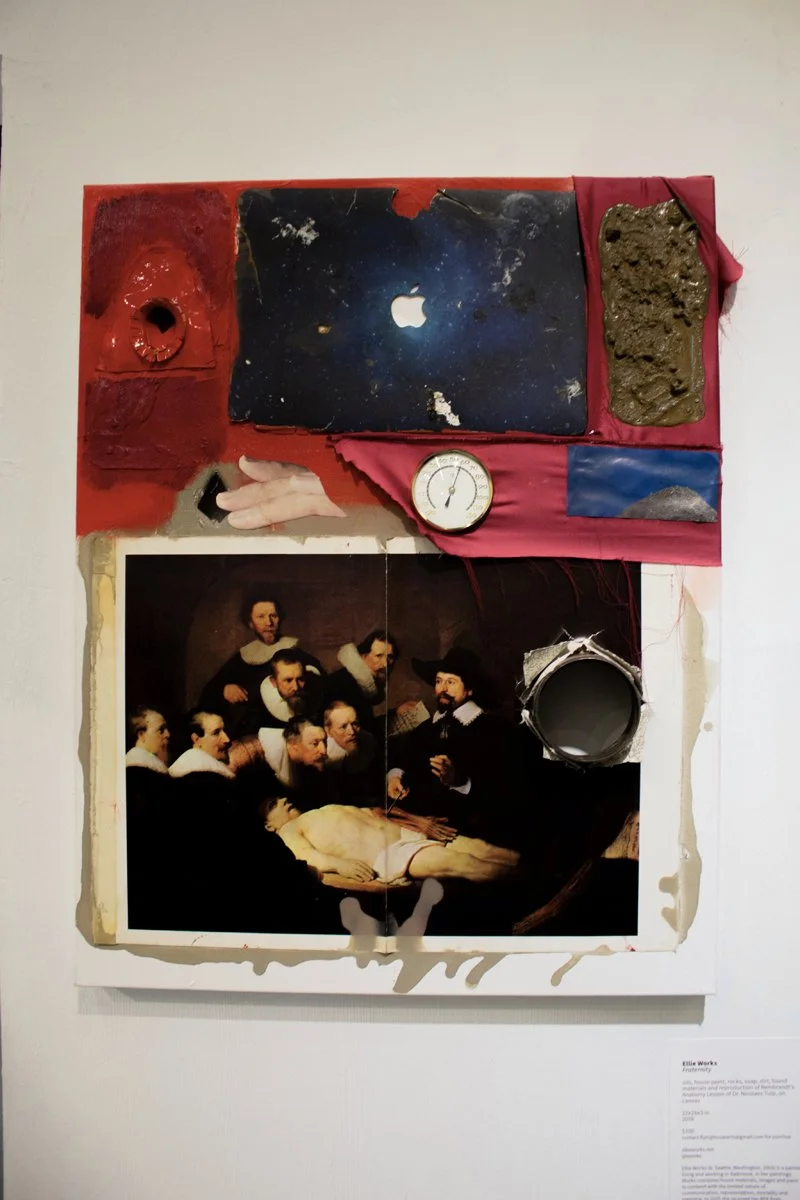
Ellie Works
In “Fraternity”, a reproduction of Rembrandt’s “Anatomy Lesson” occupies the lower half, while a pipe fitting punctures the canvas, literalizing the surgical probing depicted within the image. Above, the back of an iMac hovers against a red field, its cosmic pattern interrupted by the occasional spattering of bird shit. The work skillfully plays between multiple references of interiority. The interrogation into the body with the old master work is mimicked by a collaged cut out hand over a hole pierced into the canvas which is again mirrored by the explosion of the pipe/can like form that protrudes from the bottom right side of the composition. The resonance between these three investigations of the interior and exterior is palpable and implicates a sharp conceptual competence behind her practice. Works’ interventions also echo the exhibition’s broader concern with secondhand histories. Old master imagery, like vintage clothing, arrives laced with cultural authority, only to be cut, pierced, and reassembled into new configurations that resist singular interpretation.
EGATNIV itself operates within the broader ecosystem of North Avenue Market, a site that according to the developers plans “will house entertainment venues, bar/restaurants, local retailers, artist and maker workspaces, nonprofit arts programming space, and a large scale exhibition space.” These initiatives attempt to frame the venue not merely as a commercial hub but as an evolving cultural infrastructure. In this context, Slippy Authorship reads as both exhibition and case study: a demonstration of how alternative spaces can support experimental curatorial models. This is just what Baltimore needs and Flying House Arts Collective (FHAC) hit the nail on the head. FHAC is a network of artists that foregrounds collaboration and mutual support. Their presence reinforces the exhibition’s challenge to siloed models of authorship, suggesting that artistic production often emerges from shared infrastructures and relationships.
The market’s attitude of change, reuse and adaptation is mirrored in the exhibition’s thematic concerns. Just as businesses like Currency Studio, Baltimore Youth Arts, last year’s block-spanning exhibition Exceeds Expectations, and EGATNIV repurpose spaces and entrepreneurs test new concepts, the artists in Slippy Authorship repurpose images, materials, and narratives, treating authorship as a process of translation rather than invention.
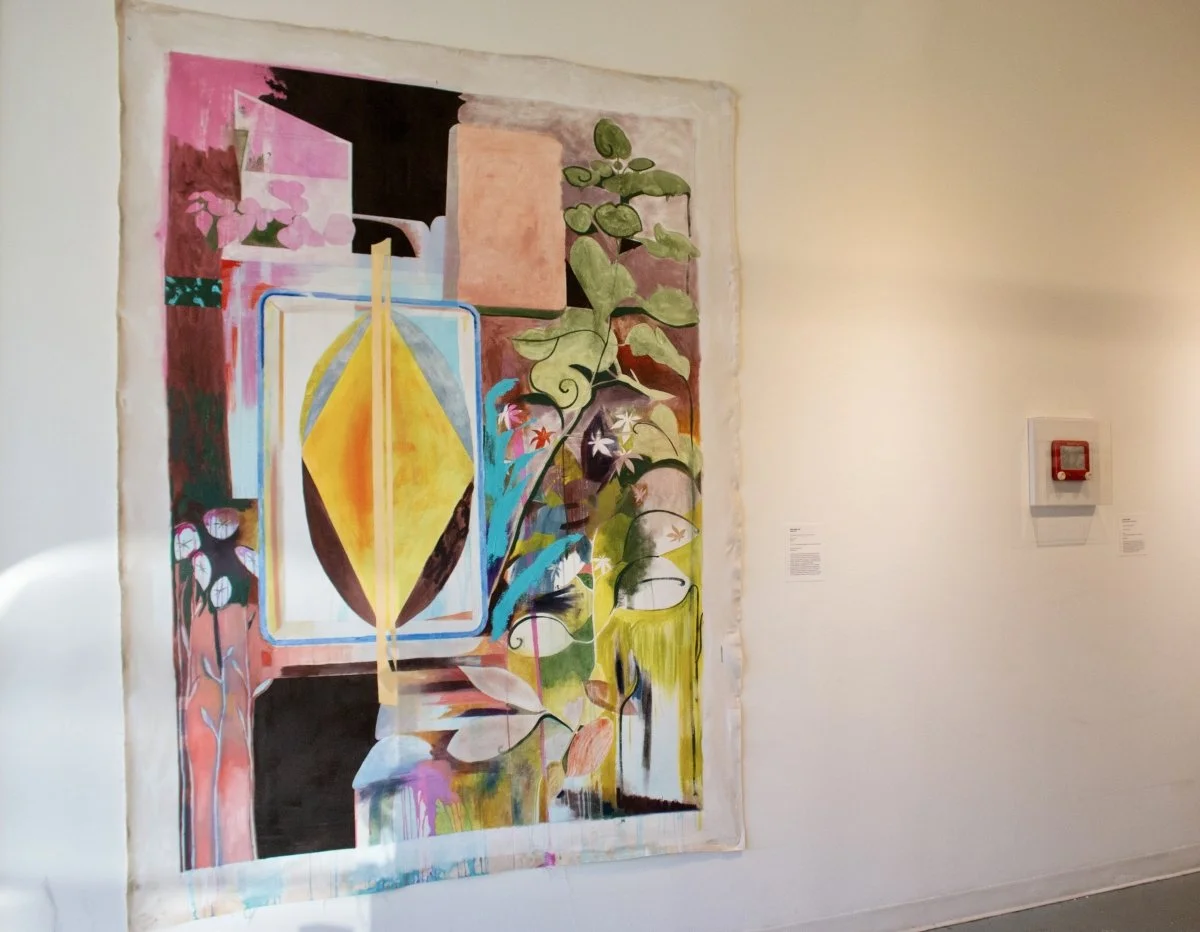
Installation view with works by Chia Hsiu Liu (L) with Yun Sun Shin (R)
Near the entrance, Chia Hsiu Liu’s large-scale painting anchors the threshold and pulls viewers into the space. Liu seems to be dancing with higher saturation levels than usual. Her iconic pastel compositions, collaging many different, often floral, elements are still present but what feels new is the use of darker, more opaque colors as well as a bold impasto swiping of a striking teal. Liu’s work is also relatively massive, the scale is not new for the artist but in the show it is a standout piece not only for everything I have already mentioned, but also its commanding presence near the entrance of EGATNIV Vintage.
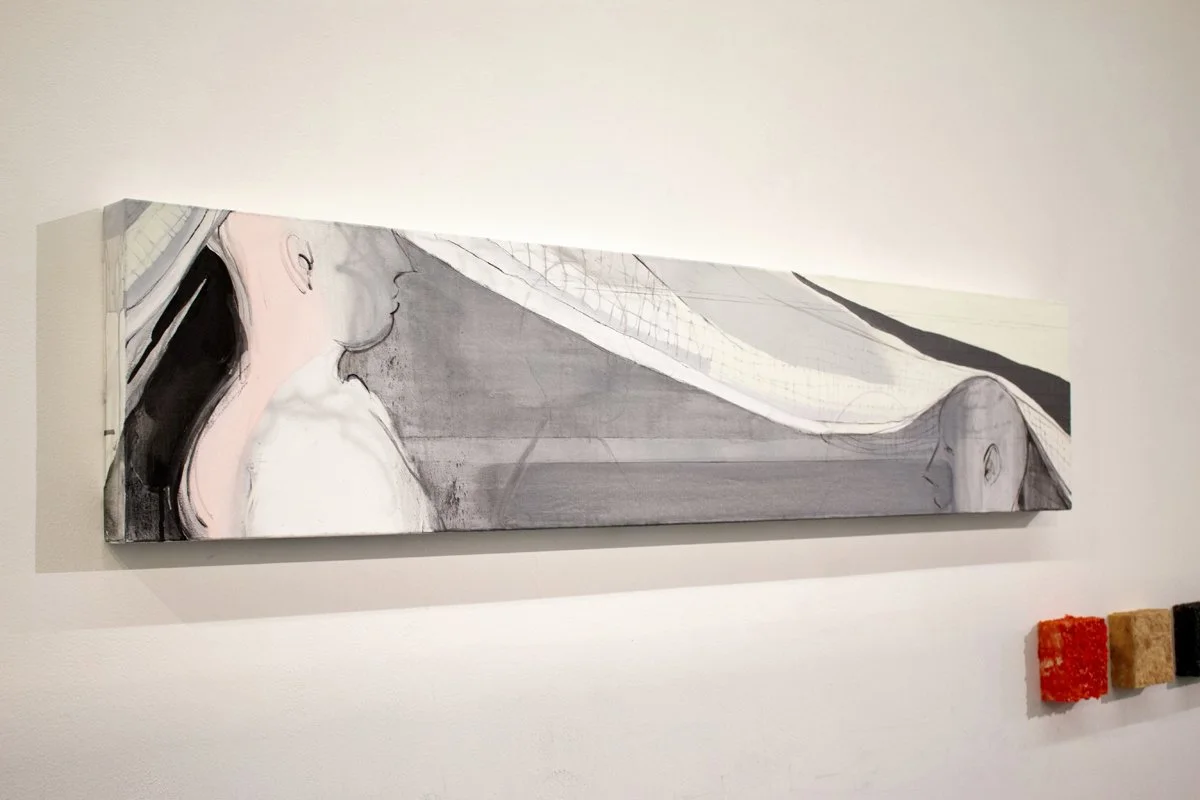
Jiang’s installation strategy emphasizes relational viewing. Works are not isolated but rather are positioned to echo and utilize architectural features. In the long central hallway, Seungju Lim’s elongated composition “Tilted gaze” emulates the corridor’s proportions, mirroring the walkway within the pictorial space. In both of her pieces in the show, Lim uses distance as both a formal device and psychological comment. In another part of the space, Lim also implicates viewers in an experience of looking and being looked at with her work “Flash.” Drawing from a photographic source she translates the authority of the camera into a composition that highlights spatial gaps and pointed gestures. A monochromatic scene depicts a figure raising a hand toward the camera, their agitated gaze is echoed by the more simplified but similarly disapproving faces in the background. Installed above eye level, the painting establishes a subtle hierarchy: the central figure looks down, the flash becomes interrogative, and the viewer is implicated in the act of capture.
Seungju Lim
Lim’s work also resonates with diasporic experiences of displacement and estrangement. They write about “the small distances between bodies and the thin air that separates people even when they stand close” and a “sensitivity [that] comes from growing up under other people’s eyes and unspoken rules.” Distance in Lim’s work is not merely compositional but also psychological, it is a negotiation between presence and otherness that manifests in the measured spacing of bodies and the rejection of narrative resolution.
Sam Weible also foregrounds process in their work, making pieces that “[focus] on ideas of recurrence [and] resonance.” In “Pressing,” the surface bears the impression of fabric or plastic pressed into wet paint, leaving traces that feel as though they could at once be additive or subtractive. While comparisons to Color Field painting are inevitable with much of Weible’s work, these particular pieces lay emphasis on recurrence and layering which suggest a system of testing and iteration that is vital to any honest artistic exploration.
Nearby, Weible’s small-scale Edible series feels more like studies into material usage. These works almost start to blur distinctions between experiment and finished object, raising questions about directionality: do the studies inform the larger painting, or does the larger work retroactively authorize the studies? In either case, these works implicate authorship as a feedback loop rather than a linear progression.
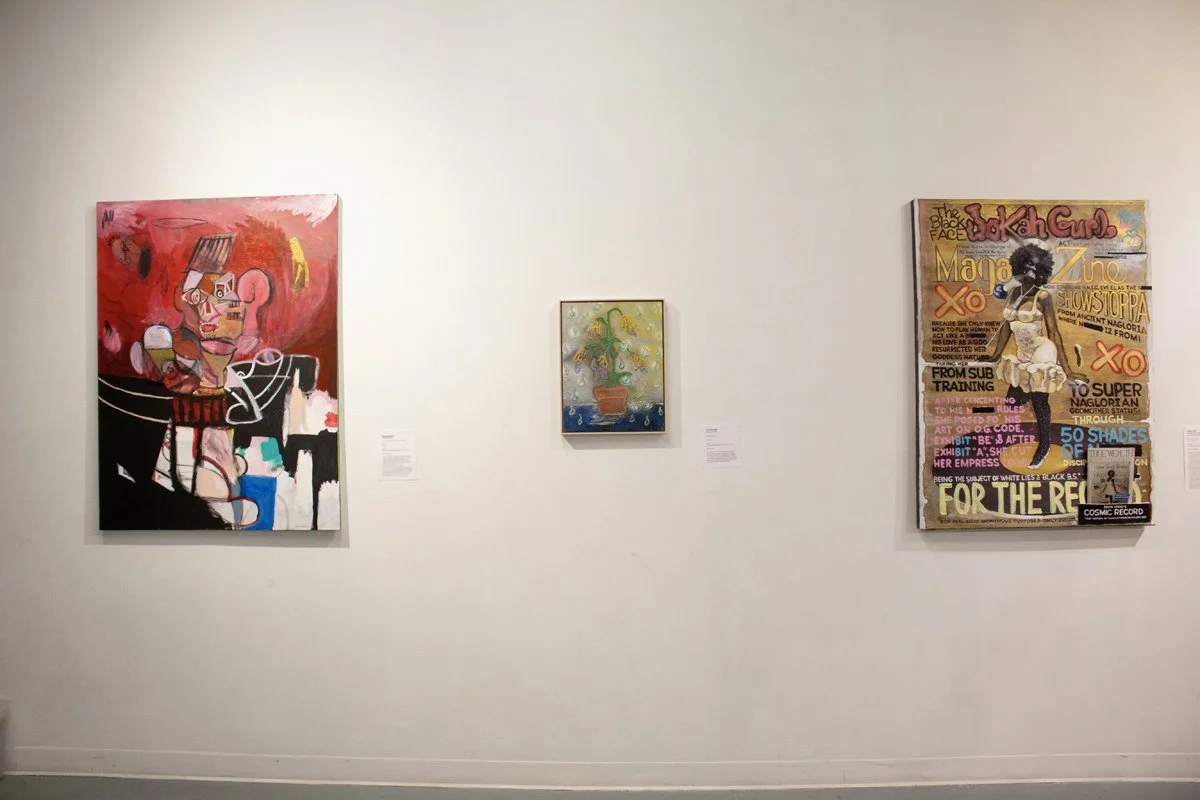
Where Weible’s work explores material relationships, BlissArmyKnife revels in visual excess. In “Shadowboxing,” figures emerge from a chaos of pinks, reds, and oil pastel marks, while the lower half dissolves into fractured patches of color that move between figuration and abstraction. The composition evokes a lineage of expressive painting from Picasso’s fractured anatomies to Basquiat’s frenetic mark-making without feeling derivative.
Installation view with works by BlissArmyKnife, Yoon Sun Shin, and Docta Toonz
In “En Garde, Foresight,” sword-fighting figures clad in argyle patterns collide amid text fragments and cartoon detritus. Eyes, teeth, and limbs generate a choreographed chaos that feels both playful and volatile. The multiplicity of viewpoints reinforces the exhibition’s interest in unstable authorship: no single perspective governs the scene.
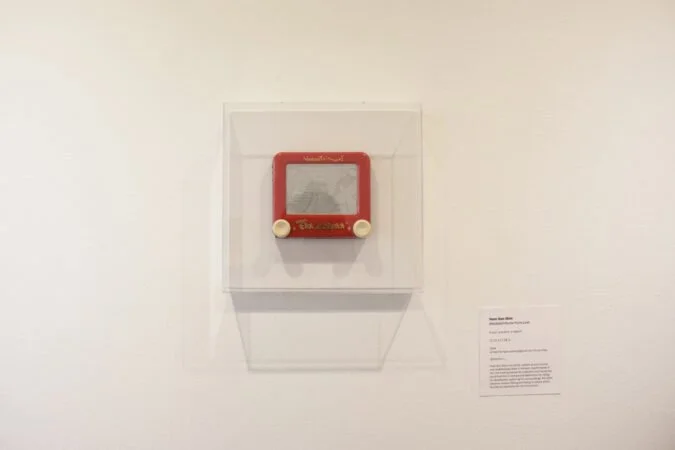
Yoon Sun Shin’s acrylic-on-panel painting “Raining Inside” could be seen as a simple still life, but the artist transforms the image into a melancholic scene with a surreal weather system. A drooping potted flower’s yellow and purple petals wilt and weep among enlarged, stylized raindrops. The artist’s use of color, in particular, creates hauntingly atmospheric moments that change this from a quickly legible image to something that rewards time and stillness. In another part of the shop, Shin is also showing one of his Etch A Sketch portraits. This piece, “Desmond Hume from Lost,” highlights variety in Shin’s technical abilities and adds a playful dimension to contrast his more thoughtful compositions.
Yoon Sun Shin
Julian Sease
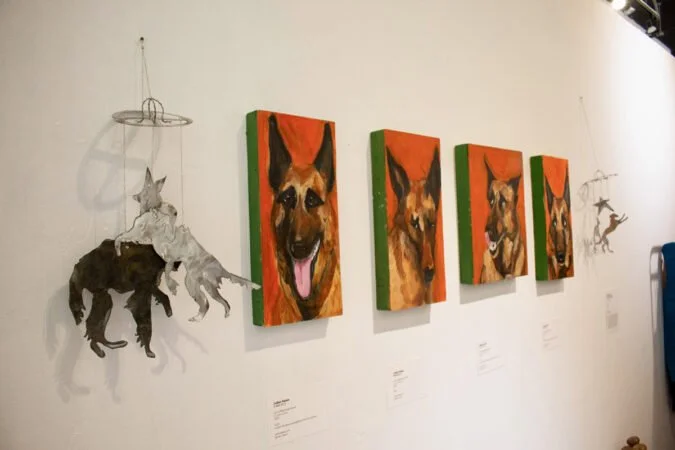
Julian Sease presents a series of canine portrait paintings that use a dog as an emotional surrogate. Works titled “3-Min Sit 6,” “Medicine 9,” and “Toe Trim 1” imply at-home training and routine pet care, framing the animal within systems of control and maintenance. Subtle shifts in posture and expression register states of anxiety, compliance, and resistance, suggesting parallels with human emotions and experiences. Using the perspective of a dog, Sease introduces a nonhuman vantage point to the show and asks the question “If authorship is already unstable among humans, what happens when the subject cannot speak?”
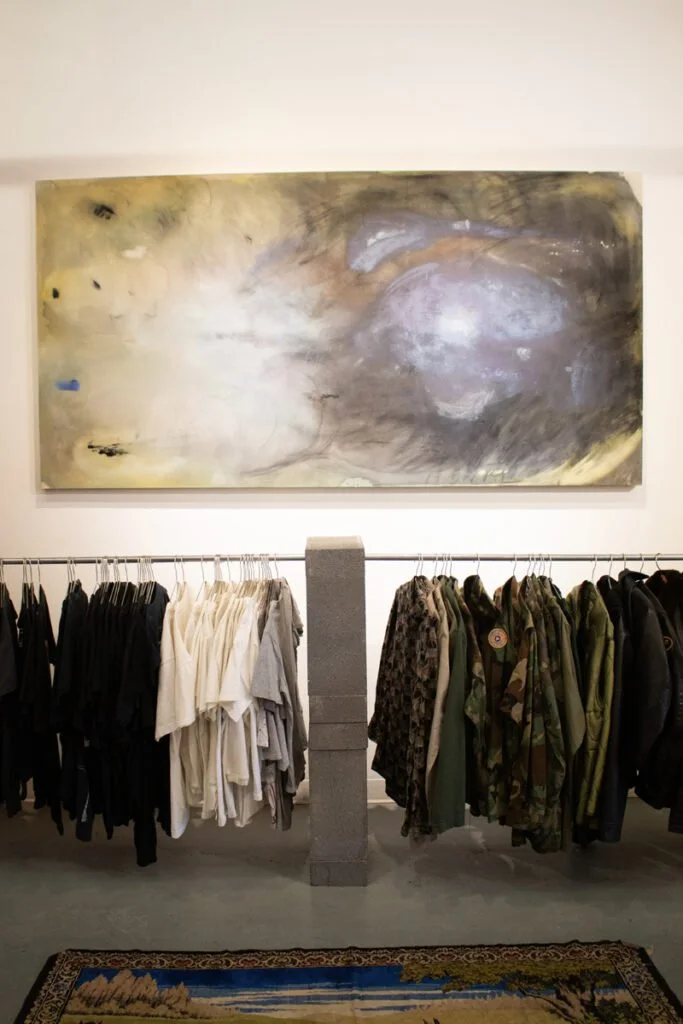
Katie Kisiel
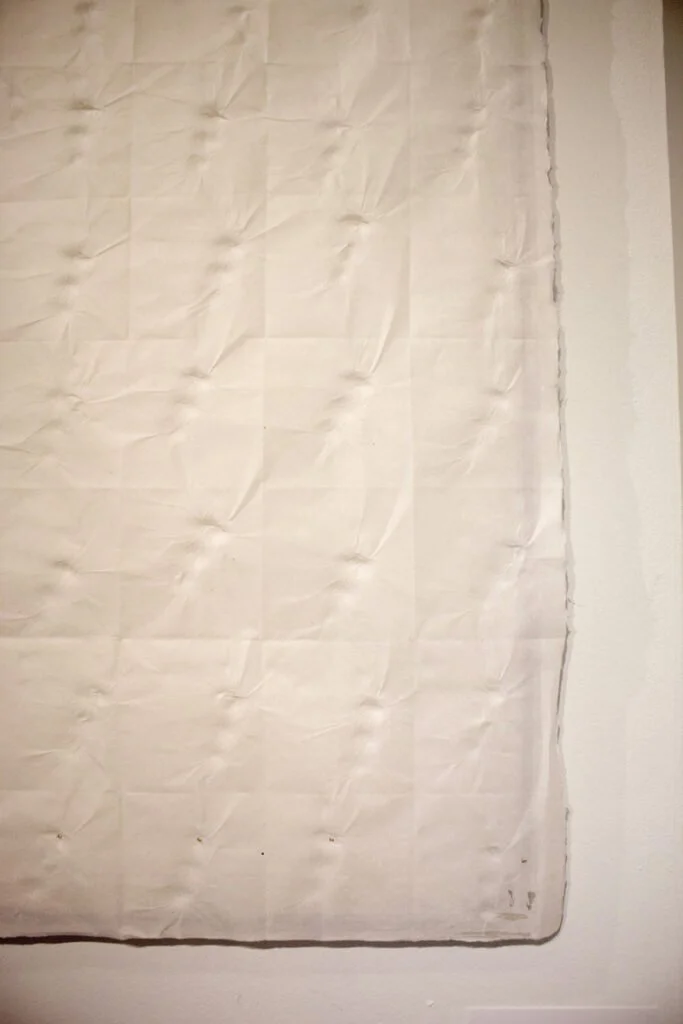
AX Quin(detail)
AX Qin’s punched paper work, “through and through,” treats surfaces as skin. The wall text lists “fist” as part of the material and to the artist’s credit, the repeated impression of a fist is very clearly present in the work. Impressed regularly in a grid-format, the work is quiet and mostly monochromatic with roughly forty eight impressions of a fist. The only disruption from the soft white form is the minute, occasional presence of small amounts of blood, presumably present from the repeated bashing of this process-based work. The recurrent impressions simultaneously suggest labor and violence and transform the delicate paper into a record of force.
The contribution of Docta Toonz introduces a deeply personal dimension to the exhibition’s inquiry into authorship. His painting, “The Blackface Jokah Gurl,” and accompanying zine document a narrative of recovery, legal conflict, and artistic self-determination. The inclusion of mugshots, redacted court documents, and painted self-portraits positions the work as both artwork and evidentiary archive. Toonz frames recovery as a reclamation of authorship: a refusal to allow addiction, legal systems, or interpersonal conflict to dictate the narrative of his life and work. Within the context of a vintage store, where garments carry the anonymous traces of prior wearers, Toonz’s work similarly suggests an engagement with narratives that he feels have been forced upon him. The zine’s documentation and the stories behind “The Blackface Jokah Gurl” propose that histories should be acknowledged rather than aestheticized.
Slippy Authorship ultimately proposes that authorship in the contemporary moment resembles custody more than ownership. Images, materials, and narratives pass through hands, accumulating residues that cannot be fully erased. By situating these processes within EGATNIV and the North Avenue Market, the exhibition foregrounds circulation as both economic reality and conceptual framework. In this environment, the viewer becomes another custodian of encountered images, ultimately altering and shaping their context. Like garments lifted from a rack, the artworks in Slippy Authorship are not fixed statements but plastic ideas, awaiting their next wearer.