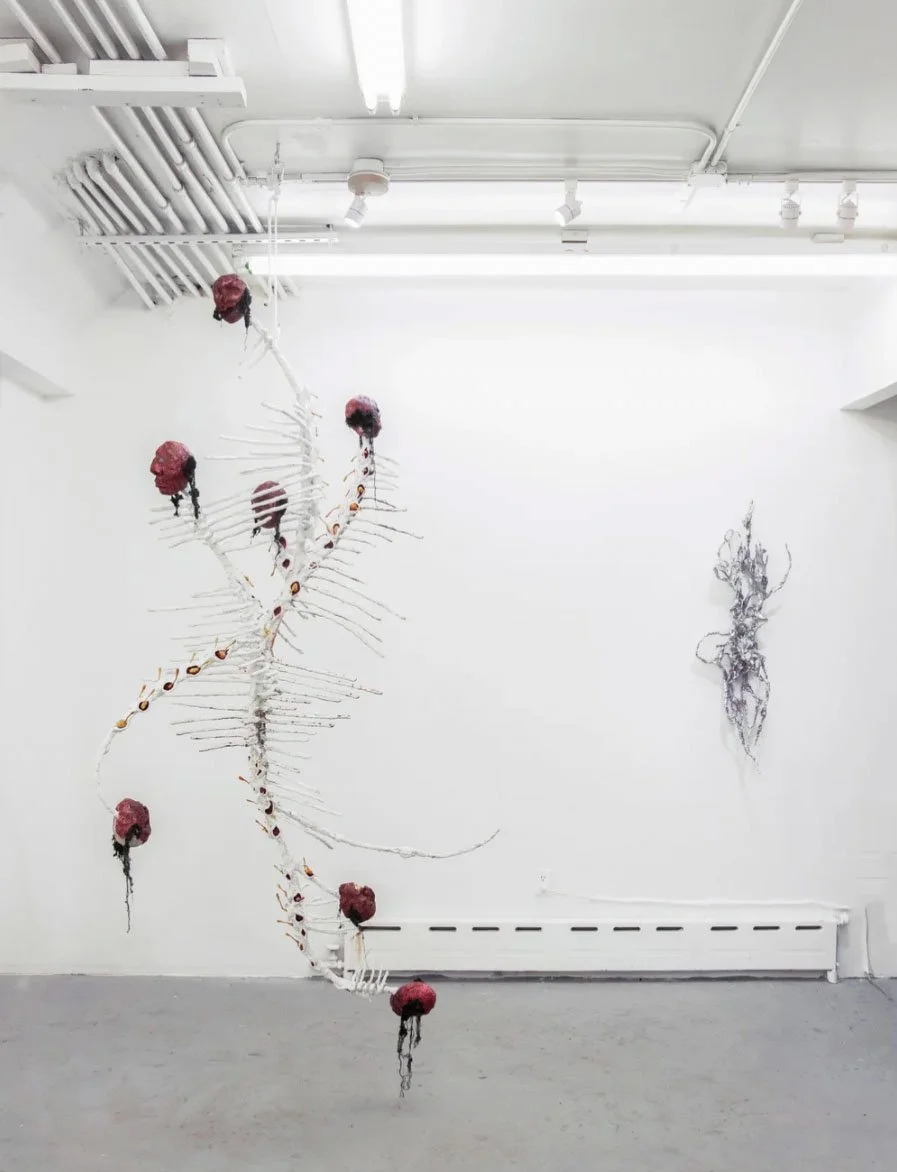
Frisson Gallery: Echo Youyi Yan & Cass Yao, Feeding the Load, Regulated Dosage, 2026, installation view (left: Yao’s Axis)
Tucked away in a cul-de-sac on Attorney Street in the Lower East Side and committed to ambitious exhibitions, Frisson Gallery is currently featuring Echo Youyi Yan and Cass Yao’s “Feeding the Load, Regulated Dosage.” It’s heavy with bodies, though not often whole ones. As soon as you enter, you’re met with skeletal forms, tangled masses, and objects that seem caught between organic growth and mechanical failure.
Yao’s large Axis anchors the front of the space with a form that feels like a collection of spinal cords, accentuated by seven shrunken heads complete with hair and teeth. Yao describes the work as three human spines intertwined and characterizes the spine as an “evolutionary failure” – a disastrously flawed and compromised product of evolution per the book Spinal Catastrophism, which contextualizes the sculpture’s sense of anatomical instability. The piece is part anatomy lesson, part ritual object, part crash debris. The red cavities and leech-like openings don’t diagram bodily order but rather speculate on how it came about.
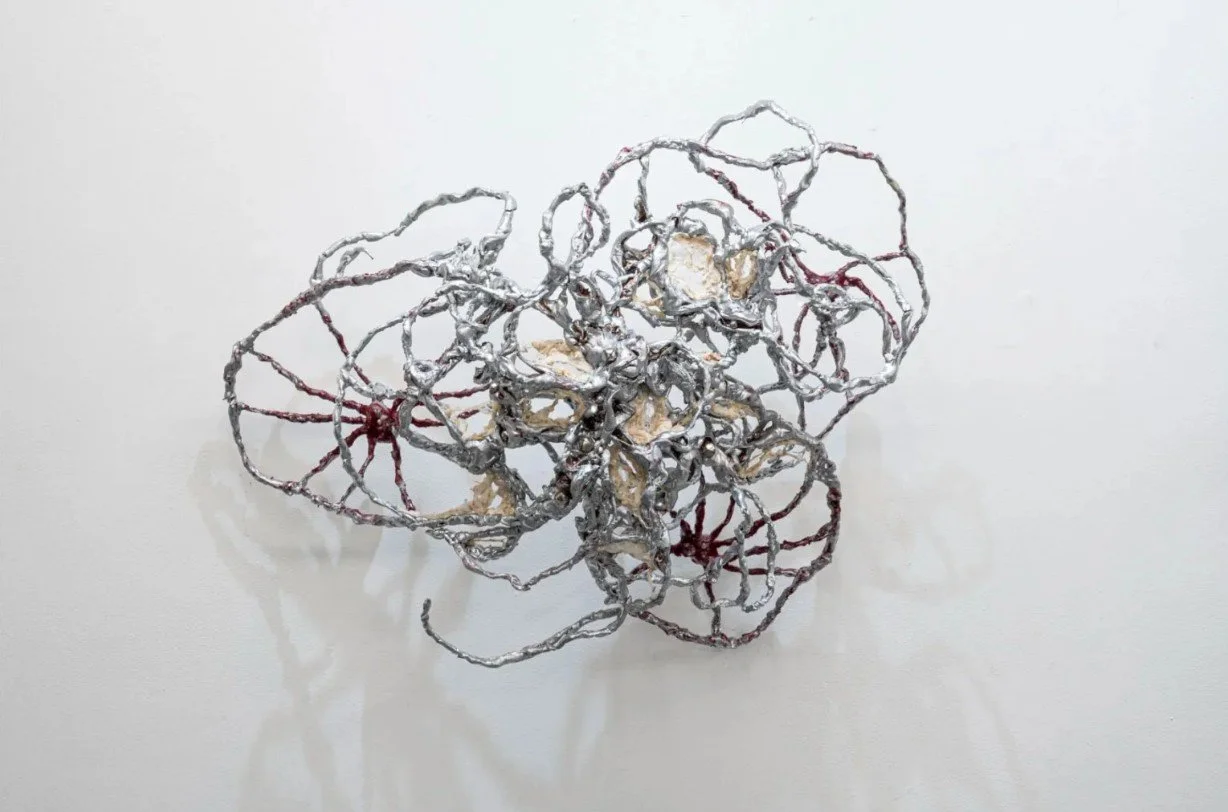
Cass Yao, Anatomy #2, Anatomy #2, 2025, epoxy clay, acrylic pigment, raw silk, silicone, velvet flocking. 34 x 24 x 12 inches
The feeling of transformation carries through Yao’s Anatomy works, which hang or spread across the walls like gesture drawings of a body that doesn’t understand its own borders. Anatomy #1 and Anatomy #2 push and pull between softness and armature. Both seem like growing entities, but Anatomy #1 comes across as metallic and almost mechanical, Anatomy #2 as live and lumpy, its transparent gooey sections and yellow pulpy material suggesting discarded medical waste or half-developed organic matter. These works are like wounds and webs within failed prostheses.
Where Yao’s work feels surgical, medical, and speculative, Yan’s feels domestic. It depicts furniture, fencing, animal training, and the bodies formed by domestic systems. Yan’s objects frequently begin with recognizable structures – a coat rack, a spinning wheel, a birdcage, and a mouse trap are some visible in this show. Each has been deformed into something uncanny, retaining enough of its original form to be recognizable but reaching far enough from it to unsettle.
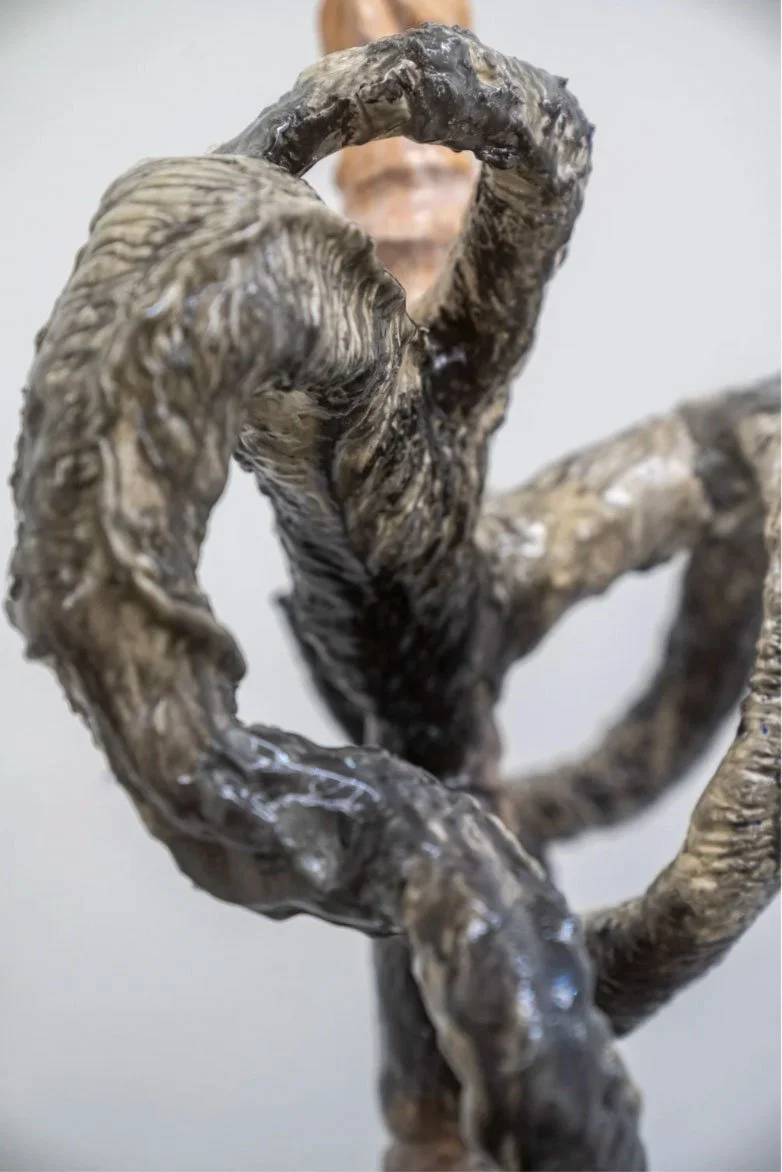
Echo Yan, Weresheep (detail), 2025, Rubberwood, Resin, epoxy clay, paper clay, 70.5 x 18.5 x 18.5 inches
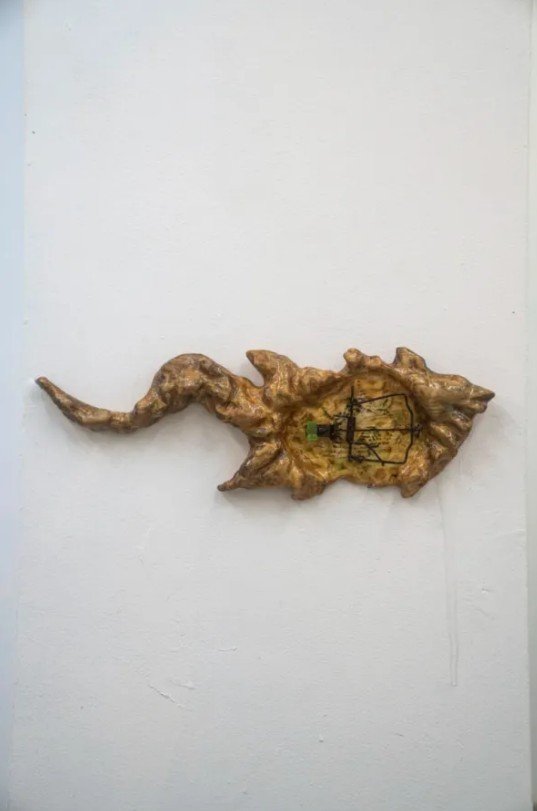
Echo Yan, Mickey Mouse Clubhouse, 2024, Clear pine, metal, resin, 7 x 19 x 2 inches
Weresheep is an especially clear expression of Yan’s interest in domestic objects. The work resembles a coat rack with hooved feet and hooks that read as ram-like horns: it’s an absurd, faintly menacing object that appears frozen in mid-transformation. It’s a hybridization, but between beast and object instead of beast and human, reflecting the artist’s apprehension of humans as self-domesticated animals.
Sometimes the absurdity and unease lean towards the humorous. Mickey Mouse Clubhouse contemplates a flattened on the street, with a mouse trap embedded like an internal organ and a cast gummy bear as bait. Yan connects this piece to unintentional domestication, noting that urban animals like rats are remade by the food waste left behind by humans. The sculpture may be the only overtly funny work in the show, but it is not necessarily lighthearted. The roadkill quality of the form and the vestigial, vertebrae-like tail keep the piece from being cute.
Curator Rui Jiang has paid attention to the structures with which bodies interact. Fences, coat racks, traps, and cages are not neutral. They separate, hold, contain, and discipline. Yan’s You May Touch the Fence is made up of slatted barrier curves and bends around the gallery. In one section, it forms a U-shaped enclosure, creating a small interior zone at once inviting and terminal. A ribbed, spiraling form hangs like a stalactite at its center above a calcified antique-looking object on the floor. Increasing this tension between utility and ruin is Yan’s The Spinner, an antique spinning wheel so entangled in its own thread that its function becomes undiscernible. The white foamy material that appears across several of Yan’s works simulates something akin to bile, rabid froth, and industrial discharge. The domestic labor envisioned here is not neat and efficient but sickly and excessive.
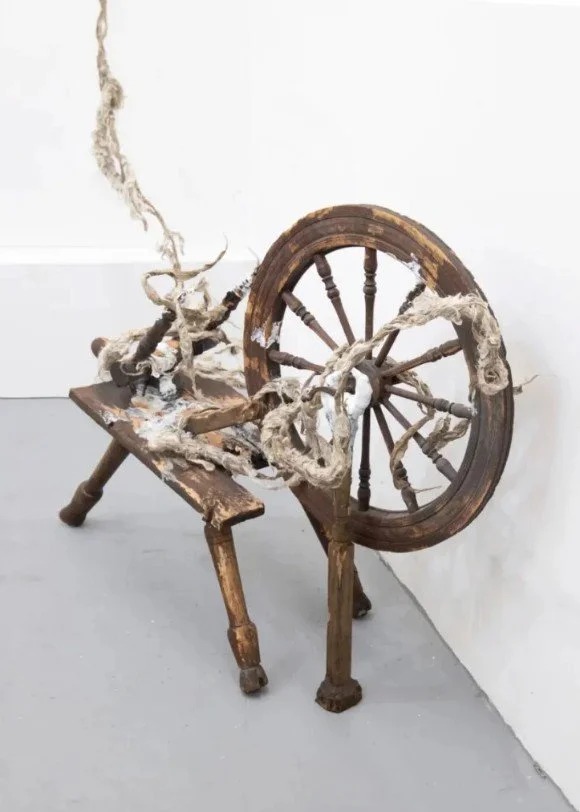
Echo Yan, The Spinner, 2025, raw wool, antique spinning wheel, pine, resin, epoxy clay, dimensions variable
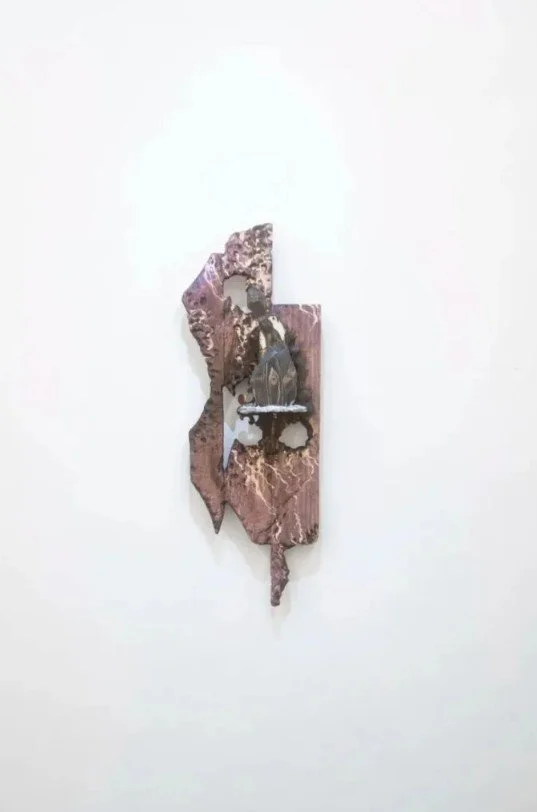
Echo Yan. Lumber Remembers Being A Tree, 2025, pine, antique mirror, epoxy clay, resin, 29 × 10.5 × 5.5 inches
Yan’s Lumber Remembers Being a Tree touches on the idea of inanimate objects retaining memory. The wood here is distressed, purple and black with veins of tan that pop against the darker background. A platform covered in the white foamy substance juts out, holding a form made of dark, charred wood as if it were an object of reverence, backed by a mirror with a tall and slender pointed arch. The mirror is obscured, but reveals hints of reflection that reward the viewer for intimate time spent
Yao’s work rarely begins from an artificial environment, Shared Meal being a notable exception. It consists of a mutilated figure stretched over a dining room table before a jagged pane of glass that seems to have served as a guillotine. Its torso opens into a cavernous interior visible in reflection as a porcelain bowl spills a sandy substance onto the table. To see into the body properly, the viewer must see themselves in the mirror and thus become implicated in the violence of the piece.
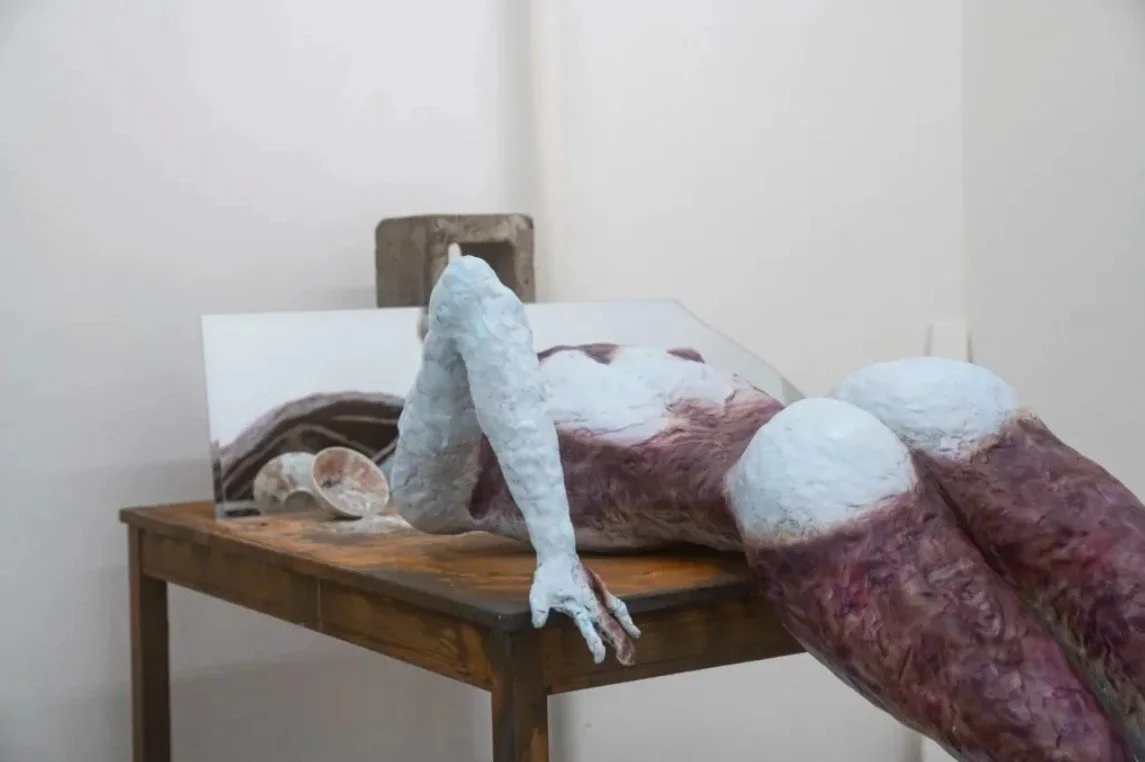
Cass Yao. Shared Meal,, 2025, epoxy clay, acrylic, rust, ceramic, powder, silicone, mirror, brick block, 48 x 86 x 44 inches
The contrasts between the artists strengthen the show, each throwing the other into sharper relief. Both artists produce works that hover between injury and transformation, but they arrive there by different routes. Yan is concerned with structures that make bodies useful. Yao is concerned with bodies that mutate beyond intelligibility. One works through the environment, the other through incision. In Yan’s work, domestic objects become quasi-animalistic. In Yao’s, anatomy becomes ornamental and diagrammatic.
What persists in “Feeding the Load, Regulated Dosage” is not simply violence. There is also a more unsettled awareness of how bodies are shaped by the things around them. Domestication can look like damage, but like care, too. While mutation can appear catastrophic, sometimes it’s just theatrical. Survival can resemble submission but also be unruly. The show presents bodies under pressure and leaves space for divergence.